
Tracing Poetic Lineage: How Poet Allegra Wilson Unlocks and Reconnects with her Poetic Mind
Allegra Wilson’s chapbook, song & ruins is the 2025 Lefty Blondie Press First Chapbook Award winner, selected by Stacey Waite. Wilson discusses how she pursued poetry after almost twenty years of inconsistent writing, and how she traces her poetic lineage to connect with who she is as a writer. She also gives us lots of great recommendations!
LBP: Do you have a dedicated writing space? What does your writing space look like? What is not included?
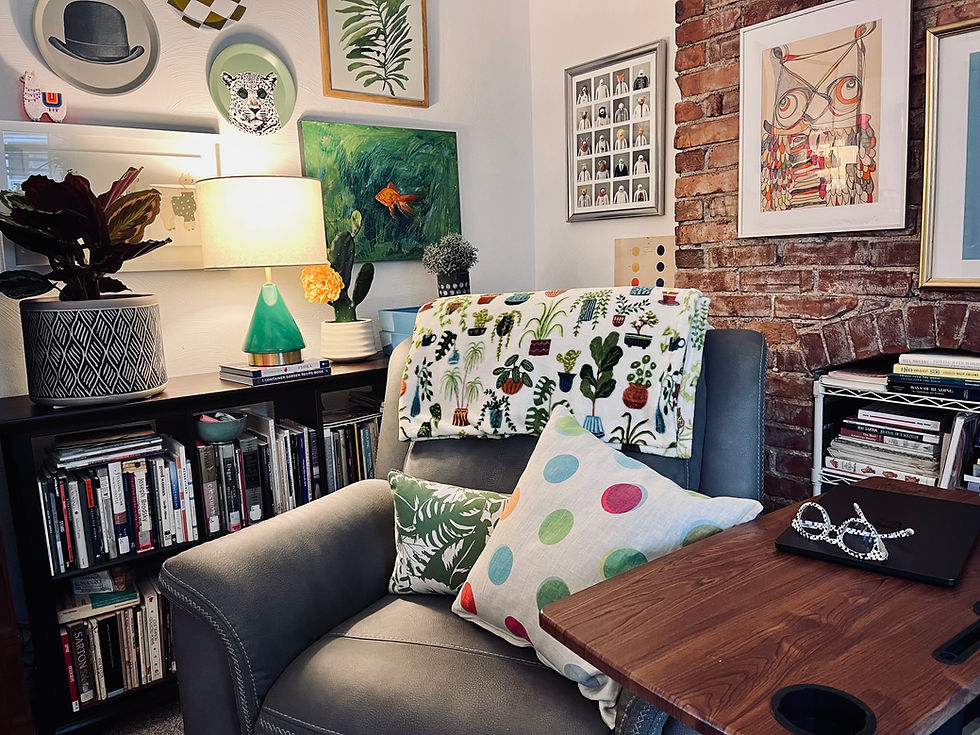
AW: I have a space at home that I love very much. It is small, with a lot of natural light, a computer, and a big work table. The walls have artwork and pictures which I’m always adding to. My tarot card collection is there, and I have candles and incense, and other ritual tools. Also, a large pile of books, and a to-do list.

I also enjoy writing outside, and that changes
my approach a bit, which is probably a good thing. I am lucky to be somewhere not too far from trees, river, and ocean– places where a lot of inspiration can be found.

LBP: Do you think of editing your own work and reading the work of others as part of your writing? What do you do in your non-generative times?
AW: Absolutely. I enjoy the shift from generative to analytical that happens for me in the editing/revision process. I find a lot of play in that space, where I can puzzle out a poem, try different ideas, push farther.
Reading other poetry is critical to my writing process. There are so many writers doing interesting, exciting work– things that make me say, “I want to try that!” I just finished reading Deed by torrin a. greathouse, a favorite poet of mine. She is so creative with both language and form, and now I want to go back to the book with a more focused eye on those things (because my first read was one hundred percent for the joy of the poetry).
LBP: How has your relationship to writing changed throughout your life? Are there clear demarcations where you knew there was a shift, or have the changes been gradual, subtle?
AW: I hadn’t written much, or regularly, for probably twenty years before I started working on song & ruins. I came to a place in my life when I knew I needed to feed myself, substantially, and I ran across a flyer for a local poetry class on Instagram, being taught by poet Kelly Gray. The first class I took from Kelly felt like an unearthing of the core of myself, it was honestly revelatory. I was hooked.
LBP: How do you approach a new project (poem/manuscript/different medium)? How do you keep the fire going for an extended project?
AW: A practice that has worked well for me in terms of staying inspired when generating new work is attempting to trace my poetic lineage. This is a great way to read more poetry and to place my work into a larger context. I’ve been able to find out more about who I am as a writer by identifying my poetic ancestors and the poets they were in conversation with during their time. This practice isn’t necessarily about finding the poets who we love the most, but about who got us here, writing what we write. Who taught us? And who taught them? What poet and what poems had to exist in the past in order for us to write our poems now? This can be challenging, too, for those of us who find ourselves outside of academia and without that structure to organize a poetic family tree within, but maybe even more important for that reason. We will write better if we see ourselves as a point on the poetic timespan, while respecting and honoring the writers and work that made us possible.
LBP: Longhand? Typed? When? Why?
AW: Typed at home, longhand in nature, both for expediency. I like to type when I can. I am often chasing ideas down when I’m writing, and I type faster than I write. I also typically do a lot of revision from the first burst of words to what becomes a poem, so having a typed version is essential to copying/pasting/deleting/moving and all that. If I’m out and about, though, I’ll have a journal and a pen on me since they’re easier to carry and don’t rely on wifi.
LBP: Do you work in any other mediums? What? When? Why?
AW: I like to play with a few different mediums. I do small works in watercolor, pastels, and pencil. I like to take/make mini instant camera prints. Sometimes when I’m feeling fancy I’ll make a little book combining both. I also really love collage, and find that creating a collage can

help me to unlock my poetry-mind. There’s something related about the two, I think, where poetry recombines language and collage recombines image, both getting at something beyond the definitional or intentional original meanings.
LBP: What can poetry do?
AW: So many things! But one thing that is high on my list right now is that poetry can build community. An ideal poetry community takes care of each other. We share knowledge, information, secrets, craft, and practice. We support each other in creative pursuits, and we don’t stop there. We use our artistic spaces (readings, writing groups, classes, etc.) to create tangible good for our community as a whole. Art is vital and spiritually necessary for people, it is true. But so is housing, food, medicine, freedom of movement. An ideal poetry community commits to action by partnering with other local community networks and movements, making space for mutual aid, creating art spaces that are accessible and safe. We use our capacity for imagination to describe a new world, and then we use our hands to build it.
LBP: Any recommendations for us? Books, poems, indie presses to follow? What about movies? Music? Museums to visit? Cool stuff we should check out?
AW:
Whittle Micro-Press! My second publisher after Lefty Blondie ❤️. Whittle is an independent digital press publishing micro-chapbooks. I think of the books as finely-crafted, super tasty little bites– the perfect amount of poetry to snack on in a sitting.
BRAWL: I love this journal! When you submit, you choose your reader. Each writer gets a write-up of their poem and an interview, plus a really cute graphic/avatar to go with it. It’s really special.
Whispers from the Void: Writer, editor, and visual artist Jamie A.M. sends snail mail from the void that might look like a postcard, prompt, artwork, or something else. It’s always a fun and thought-provoking surprise when a whisper arrives.
Kelly Gray’s latest poetry collection, Dilapitatia. Stunning, haunted, obsession-worthy poetry. Available from Moontide Press.
LaRusell is a rapper from Vallejo. His music and shows bring so much joy! Plus, his shows are usually in the afternoon, which means people of all ages show up. His Tiny Desk Concert is a great introduction.
Neon Raspberry Art House: A magical art gallery and shop in Occidental, CA. Founder & curator Mahea Campbell has created a space that centers excellent art by BIPOC, queer people, youth, and radical creators. Madeleine Boga, the cover artist for song & ruins, showed at Neon Raspberry; I found her work scrolling through the Artists page on their website.
Two Trees Tea House: Also located in Occidental, CA, this is a beautiful space for community, conversation, and tea! Chris & Adrian Lewis-Chang are the husband-and-husband team and founders of Two Trees Tea House. They share their passion for tea and ritual by offering community tea service as well as hosting events like game night, vinyl night, and workshops on watercolor and calligraphy.
Books & Barns is a speakeasy-style literary event series happening in West Sonoma County. Attendees register without knowing the location, get directions the night before, and are led to the beautiful edges of the world (cemetaries, estuaries, abandoned barns) to listen to work by poets, fiction writers, and creative wordsmiths of all varieties.
Russian River Books & Letters is a bookstore in Guerneville, CA with a great poetry section and a blend of new and used books. Owner Michael Rex keeps books by local authors available and highlighted, and holds regular readings. There’s also a typewriter for letter writing!
Breaking Form is a poetry podcast by James Allen Hall and Aaron Smith. It’s so much fun– informative, thought-provoking, raunchy, and queer. James and Aaron talk poetry and poets, play literary games, and read poems. I’ve developed a deep parasocial relationship with them and look forward to the episode drop each week.
LBP: BONUS QUESTION: Answer a question we haven't asked. : How have you used poetry in your personal life as a tool for resistance?
AW: The practice of writing poetry has given me a tangible expression of the advice that “your no makes room for your yes.” In order to write, I have to say no to the demands of the world, I have to clear space in my mind from the shock and awe tactics of a fascist administration, I have to create and maintain boundaries that allow me the space and time to imagine, explore, deepen, create. Poetry also demands that I know myself and write the parts that are ugly, misshapen, unlikeable, deviant. This is different from writing about how I have been hurt (although that can be a part of it). As a woman, a femme, a fat person, this type of writing violates the cultural education I was given to be sweet, small, and pleasant no matter the internal cost. It is a vulnerable place to come from, and an important liberatory practice.
Open to self-identifying women or non-binary poets of any age & any publishing history!
The Poet of the Selected Poem will Receive:
25 (twenty-five) copies of their poem in an original limited-edition handset letterpress broadside designed and printed by Ryan Kaune
Praise, adoration, and promotion through social media, literary festivals, independent booksellers, & any other collaborations LBP seeks out.
Finalists may be offered publication as part of LBP's Letterpress Series
Reading Fee:
Pay-what-you-can reading fee via Duosuma tip jar through November 15th! We want to read your work & we don't want the reading fee to keep you from submitting.
BEGINNING November 16, 2025: $5 reading fee per submission
ALL submissions are read by LBP editors & readers with openness and attention, regardless of what you're able to add to our tip jar.
All tip jar donations support LBP's mission to promote the poetry of self-identifying women and non-binary people.


Comments